
Summit Carbon Solutions Host Open House In Primghar
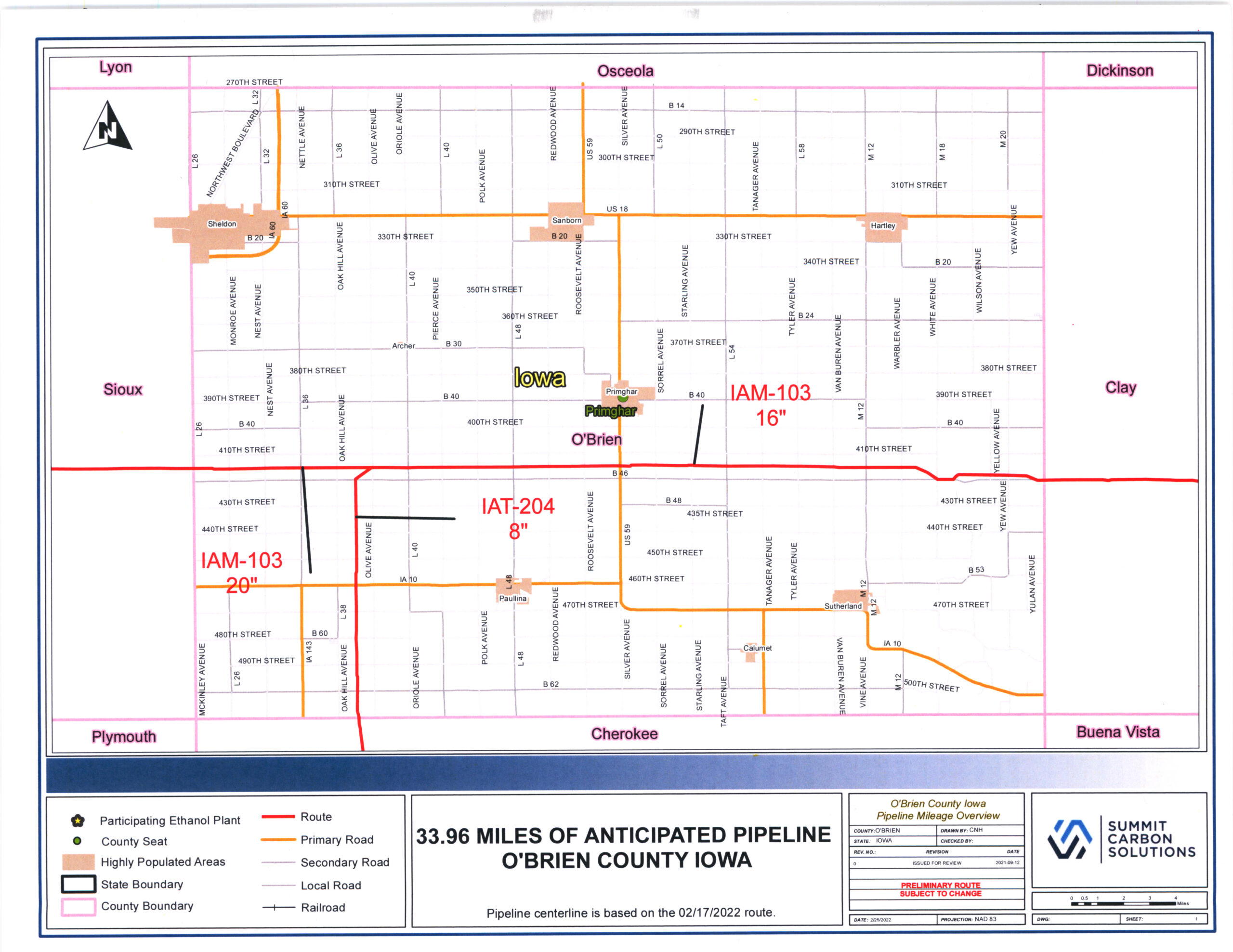
Summit Carbon Solutions held an informational meeting at the Primghar Community Building on Tuesday evening April 5. Landowners were invited for information and a meal. A crowd of approximately 30 people attended.
Jake Ketzner, Vice President of Government and Public Affairs led the discussion. The Summit Carbon Solutions project across Iowa is a pipeline project directed toward the capture and permanent storage of carbon emissions. Because Summit Carbon Solutions’ parent company, Summit Agricultural Group is an business centered in the agricultural world they are focused on ag related businesses and carbon dioxide. The current plan is to connect fertilizer and ethanol plants via pipeline for the capture of the carbon bi-product. The pipeline ends on 110,000 acres in North Dakota where underground storage up to 350 billion tons of capacity is already ready for carbon injection for permanent storage approximately 1 mile underground. The North Dakota land has a geological feature called a “cap layer” that the Iowa geology lacks.
Ketzner offered the planned construction schedule to begin in 2023 with the pipeline going operational in 2024. He also pointed out on several occasions that Summit Carbon Solutions does not currently have any permits. That any money it pays out prior to being granted permits by Iowa Utilities Board (IUB) is pure risk to the company and the investors. Summit currently also lacks imminent domain authority.
Ketzner reported that as of Tuesday evening an estimated 40% of the necessary easements have signed voluntarily and have been paid. Ketzner reported a new development in the company’s reimbursement schedule. Management decided to pay crop damage at the same time as easement signing. He spoke very clearly saying that there is no claw back provision in any document. Once the money is paid, whether or not the project proceeds, the money belongs to the landowners. He said the current offer is for 115% of fair market value, which is developed from count CSR records. Those who have already signed since the change in crop loss payments will be receiving another check.
An additional announcement made by Ketzner was the lifetime tile warranty. Ketzner explained that should any drain tile damage by attributable to the Summit Pipeline it will be repaired at no cost to the landowner in perpetuity. He explained that perk is written into the easement.
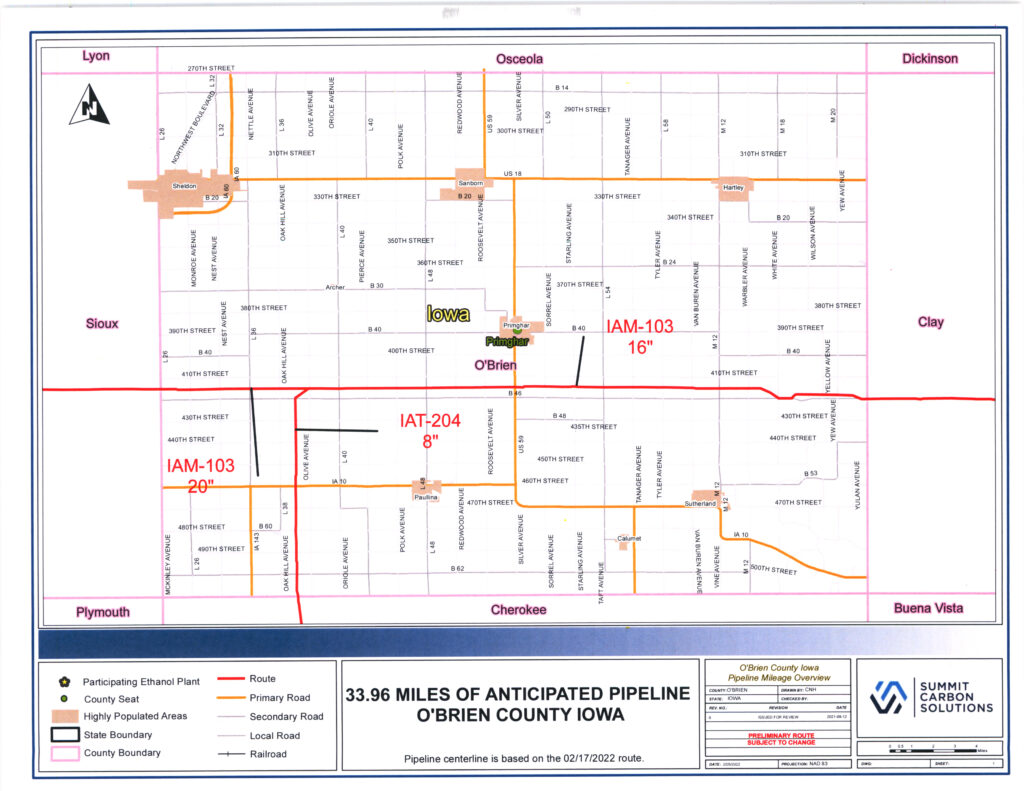
Briefly, Iowa currently has 42,000 miles of pipeline. This project proposes adding and additional 641 miles, most of it running east to west, but O’Brien County is the intersection of a north/south pipe with the main line. Further describing the project, Ketzner noted that Pipeline and Hazardous Materials Safety Administration (PHMSA) rules require pipeline depth at least 3 feet to the top of the pipe. Summit has adopted a policy of a minimum of 4 feet to top of pipe. O’Brien County Supervisors have expressed a desire for a minimum 5 feet depth. According to Ketzner, depth is a negotiating point. Ketzner outlined a variety of additional safety precautions adopted by the company in the planning “above and beyond.”
The current property tax impact estimate to each county, should the pipeline become operational, is about $1 million.
Ketzner fielded dozens of questions from landowners. Questions ranged from concerns of construction specifications and impact, to crop damage, future yield, employment impact, and safety. Ketzner addressed each question.
When asked where the money is coming from Ketzner explained that about 60% of the investors in the project are Iowa based and include John Deere, Tiger Infrastructure and others. Their goal is to raise approximately $1 billion in capital. Should the project be successful, they will issue about $3 billion in bonds.
Safety concerns brought out many questions including a carbon pipeline explosion in Mississippi not long ago. Ketzner outlined the differences between the contents of that pipeline and the proposed Summit pipeline. Summit plans pure carbon where the Mississippi pipeline had additives and that the purpose of the Mississippi Pipeline was to assist with oil extraction. Summit is not trying to make use of the carbon. Ketzner also noted that all emergency response organizations along the pipeline route would be provided with specific training to protect the citizens. When challenged about the asphyxiate nature of carbon Ketner’s response was that carbon lays low and produces dry ice in a limited area.
Income to the company is expected to come in the form of the 45Q tax credit of $50 per ton of sequestration. Only sequestered carbon is eligible for this tax, and the sale of low carbon fuel at a premium to new markets such as California, which currently does not sell Iowa produced ethanol.
For more details about Summit Carbon Solutions visit www.summitcarbonsolutions.com. Terry Branstad is a member of the team as Senior Policy Advisor.