
Carbon Sequestering Pipelines Drawing Attention
By Mari Radtke
The O’Brien County Board of Supervisors moved their regular monthly meeting to the Assembly Room on Tuesday November 23 anticipating a large turnout of “concerned farmers and landowners” with questions and concerns about a second pipeline planning to go through O’Brien County to transfer pressurized carbon dioxide from ethanol plants. The proposal intends to move captured carbon emissions from ethanol plants in 5 states; Nebraska, South Dakota, Minnesota, Iowa and Illinois and transport them to a remote location in Illinois to be stored underground. This is the second such pipeline proposal affecting O’Brien County land in just 3 months. A second pipeline, Summit, has held their public meetings and will transport CO2 to North Dakota for permanent burial.
Rich Vander Werff opened the discussion thanking the barely quorum of supervisors for their time and willingness to listen to the concerns and provide as many answers to their questions as possible. He also assured the board they were there to express genuine concerns and ask questions. According to Vander Werff, the strong turnout took very little effort. He said, “There was no concerted effort to have people come.” Attendees numbered between 25 and 30. Vander Werff also noted that since then he has received a number of calls and texts including absentee landowners. When asked what the consensus of the landowners was, for or against the pipeline he said, “against. In fact, I have not gotten a single call or text in support of the [CO2] pipeline. For clarification of which pipeline landowners are against, the answer is both Summit and Heartland Greenway Navigator.
Supervisor Dennis Vanden Hul responded to the crowd that the job of the supervisors is to figure out which side of the issue the supervisors will support. He noted to those in the room that there are some people out there who are for the CO2 pipelines.
Navigator CO2 Ventures LLC is the project developer. It is incorporated in Delaware with its home office in Greenwich, CT. Its registered agent in Iowa is “Corporation Service Company in Des Moines, IA.
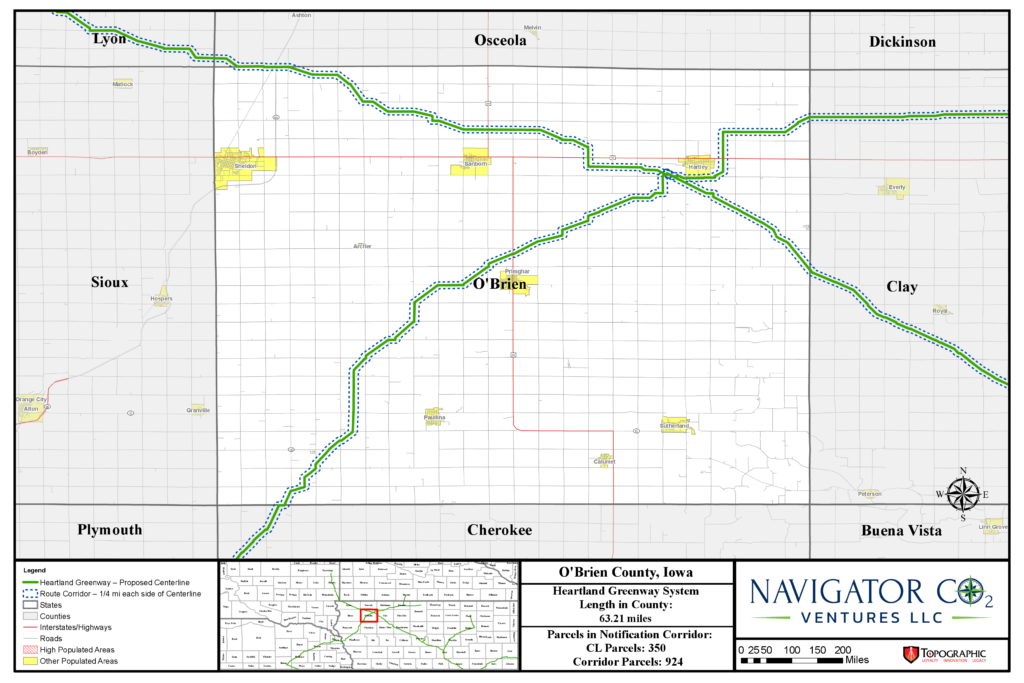
The project proposed across Iowa and particularly in O’Brien County is described in corporate information provided to affected landowners as approximately f1300 miles of 6” to 24” pipeline constructed with high-strength carbon steel. The transportation and storage capacity is up to 15 million tons of CO2 per year when fully expanded, although it is unclear if that capacity is for the pipeline alone or for the pipeline and its underground storage.
Beginning in the spring of 2022 and through the fall of 2023 the project timeline calls for route feasibility, field due diligence, environmental permitting, engineering design and right of way acquisition. Pipeline installation, land restoration and commissioning is scheduled to occur from spring 2024 through summer 2025.
Navigator describes the economic impact as property tax revenue for communities and counties along the rough for the life of the project; union and non-union contract positions during construction, up to 8,000; approximately 80 permanent jobs along the pipeline route and increases in technological improvements and competitiveness of value-added ag products.
The added property tax value to O’Brien County (rural) was calculated using current levies and values to be approximately $60,000 out of a $7.2 million budget.
Navigator advocates the safety and environmentally friendly nature of pipelines as the “most reliable method of transporting of the energy we use everyday.” This Heartland Greenway pipeline will be regulated by state and federal agencies from design to construction and operation to assure compliance. Attendees Tuesday refer to the high pressure of the CO2 pipeline as cause for safety concern. The general belief is that the CO2 is pressurized to 2700 PSI, although no one from Navigator was immediately able to confirm or refute. Another safety concern expressed was that CO2 when mixed with water creates carbonic acid which is very lethal when breathed. The proposed pipeline route brings the pipeline within at least 2 miles of the cities of Primghar, Sanborn and Hartley.
Over 5,000 miles of CO2 pipelines are in operation today. They believe the development of pipeline infrastructure Carbon Capture & Storage (CCS) could reduce global CO2 emissions by as much as 20% and “lower the cost of addressing climate change by 70%.”
Navigator provided limited information about right-of-way (ROW) and the use of the land after construction such as kinds of disallowed plants or digging or storage on the pipeline easement without consulting the company.
One gentleman attending the meeting offered several times that much of the land is in a drainage district and that a drainage district has first easement and can set rules more easily than private landowners with regard to additional easements or possibly imminent domain. The O’Brien County Board of Supervisors act as the trustees for all of O’Brien County’s drainage district.
Miles of tile, drainage districts, natural gas, public water sources and now electric power lines from wind turbines create enormous challenges for additional underground pipes, particularly such large pipes. Pipe sizes to be used for Heartland Greenway is from 6 to 24 inches in diameter.
The pipeline is to be buried 60 inches minimum depth. Constant monitoring is standard and includes foot, vehicle and aerial patrols as part of frequent and regular maintenance of the pipelines and ROW. Monitoring includes a state of the art leak detection system monitored by skilled operators. Internal pipeline inspections occur periodically using an in-line inspection tool, “smart pig” which validates the integrity of the pipeline.
Landowners present on Tuesday indicated significant concern for the condition of their land after construction. They look at their experience with Dakota Access and are committed to the belief that the land does not fully come back for years, if ever. They also look to their most recent experience with a pipeline and express skepticism that the soil will be returned as it was removed. Pipe size differences are one of the drivers of the doubt. When comparing tile or natural gas lines the 4” – 8” lines and the methods and tools for digging are very different from excavation and other heavy equipment damage.
Farmers are concerned about the condition of their cropland once it is returned to them after construction. They are convinced that the level of disruption and depth does impact the productivity. Most landowners take the position that the soil is not returned properly and the compaction disruption does not resolve in just a few years. Navigator says they have “retained a specialized restoration company to develop and execute a project specific restoration plan.” Navigator goes on to tell the prospective landowners that this plan will address the unique conditions of agricultural practices along the ROW to ensure all impacts from construction are temporary and that land use and production are restored as quickly as practical. They say they will address each specific circumstance during easement discussions. The end that discussion with, “We are committed to returning the land to its pre-construction conditions or better.”
There is no mention in the promotional materials distributed by Navigator. There is a question of the use of the pipeline for material other than CO2 and any point in the future. They also have concerns about “the end game.” They ask, “How do these companies benefit by forever burying CO2?” Compensation will not be discussed in northwest Iowa until after public meetings are held.
Public meetings in northwest Iowa are scheduled for every affected county. In northwest Iowa the choices are: Wednesday December 1 at Crossroads Pavilion in Sheldon at 12 noon, and Osceola County, 9th Street Center in Sibley at 6:00pm. December 2 meetings are in Dickinson (12 noon) and Emmet (6:00pm) Counties. Clay and Buena Vista Counties will hold their meetings on December 13 at 12 noon and 6:00pm respectively.
The full schedule can be found on the Iowa Utilities Board (IUB) website. Comments about the project can also be submitted to IUB.