
Gaza Forum Speaker Outlines Constitutional Amendment Procedures

by Mari Radtke
A larger than expected crowd traveled on a cold Iowa night to the Producers Coop warehouse in Gaza, Iowa on Saturday night. Presenter Tamara Scott provided some history of how the United States got the Constitution we currently have and spoke to the methods of amending it. The issue at hand is a national push by highly paid presenters to organize a sufficient number of states to hold a Constitutional Convention, now called a Convention of States. Scott is the National Committeewoman, Iowa, Republican National Committee.
Article V of the Constitution describes how the Constitution can be changed. Twenty seven times two-thirds (2/3) of Congress and three-fourths (¾) of states have ratified an amendment. The first ten are known as the Bill of Rights. Article V of the Constitution also allows for the people, through a Constitutional Convention or Convention of States (COS) to approve constitututional amendments. Scott pointed out that the Constitutional Convention method was used one time since 1787. It was billed as improvements and ended up as a complete overhaul. She cautioned about COS that constitutionally, there are no rules in what or how amendments or language gets changed. She was clear about her concern that the effort is heavily funded with “dark money”. She suspects that money funding the push for the COS comes from other countries. She is a believer that the goal of a one world government is behind the effort. She named several paid proxies advocating for the COS including Rick Santorum and Mark Meckler.
During her hour plus thoughts about a COS she reminded us that opposition to what the Constitution says has existed since before the first one was adopted.
Scott clarified misleading statements attributed to Ronald Reagan’s support for COS – she even played a recording of Ronald Reagan’s views about amending the Constitution. What he said was that a Constitutional Convention is a safety valve when Congress won’t act, “I myself prefer the legislative method.” One danger of a COS is there cannot be a limit on what is proposed there. Many court rulings support this. Further, the Article V gives no rules in holding a COS; how many states must hold a Convention, what is the required margin; who can be a delegate; who would a delegate represent? So many unanswered questions about how a COS amends the Constitution.
Problems exist with the Constitution, according to Scott. Not that the governing roadmap isn’t within its text, but rather that it is being ignored.
The effort to hold COS targets three amendments: require a balanced budget, Term Limits and Rein in Government. Scott reminded the gathering that the requirement of a balanced budget would do two things, 1) not allow a government to borrow money during a time of need and would cause a loss of sovereignty. Term limits, to her, should not be imposed in law but rather a system of Reward/Removal should replace such a Constitutional amendment. As to rein in government she asks what that even means. Her response to all of the pressure paid for by some unknown source is simply that you can’t correct behavior by changing a document. It is a reminder that the elected officials are the problem, not the Constitution.
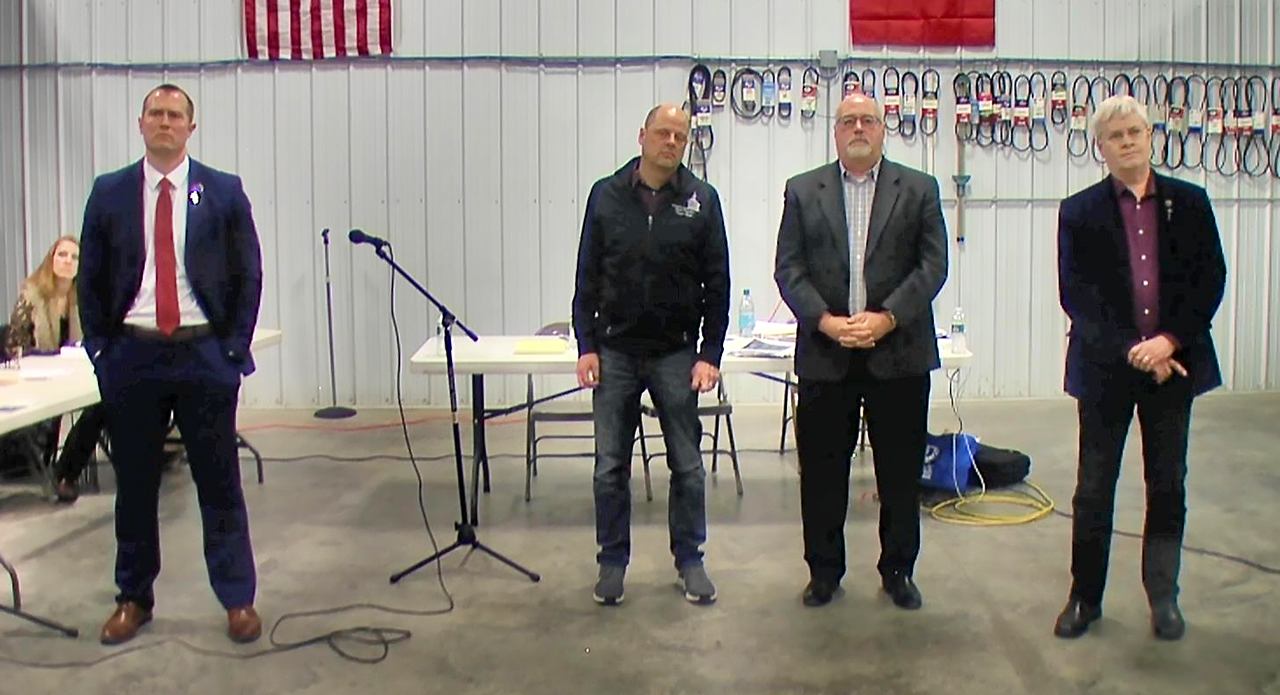
Following the presentation opposing the COS, four area legislators attended and updated those interested in what is happening in Des Moines. The lone State Congressman, Zach Dieken spoke about his efforts toward medical freedom, his co-sponsorship of legislation to amend the governor’s emergency powers and changing IUB board members from governor appointments to elected officials. He also shared an evolving issue with paid (with tax dollars) pornography in prisons and other public institutions. Without elaborating, he said the proposed legislation “opened a can of worms.” He is a passionate supporter for the unborn.
State Senator Lynn Evans became the Assistant Majority Leader this session, a big honor. He also chairs the Education Committee. He is pushing for the “Fetal Development” bill. This bill will require the addition of fetal development to human development curriculum. The goal is to give youth factual learning of human development before birth. He is a powerful advocate that school funding, whatever it turns out to be, is sustainable, speaking from experience when the statewide education budget endured untenable cuts.
Senator Kevin Alons is Vice Chair of the Technology Committee. He shared that there are several bills under consideration and that “big tech” is looking for carve outs. Other legislation include privacy bills and they are working to address porn access in public environments. Under consideration is the creation of a “gold Iowa currency.” He says it is a move away from the dollar, which is not grounded in a gold standard, but rather managed by the Federal Reserve. He explained that many states are discussing the creation of their own currency.
Senator Jeff Taylor is Vice Chair of Education and supports the Fetal Development bill. He also opened up about a couple of bills addressing the pipeline. One bill works to define a common carrier. The other addresses surveyors trespassing when not given landowner permission to be on private property. Taylor was very clear that he does not support the carbon pipeline being able to use eminent domain. He went a little further is explaining that the permanent sequestration of carbon makes the carbon going through the pipeline not a public use product, which, according to him, not eligible for eminent domain. Taylor described himself as a political scientist and very well versed in both the federal and the state constitution. He supports a medical conscious bill for both products and practices. He specifically referred to his opposition to Bayer being exempted from lawsuits for harm caused by Roundup.
The entire event can be viewed on our website: belltimescourier.com, including being able to hear questions from the audience members and the legislators responses.