
Insight into our Elected Officials
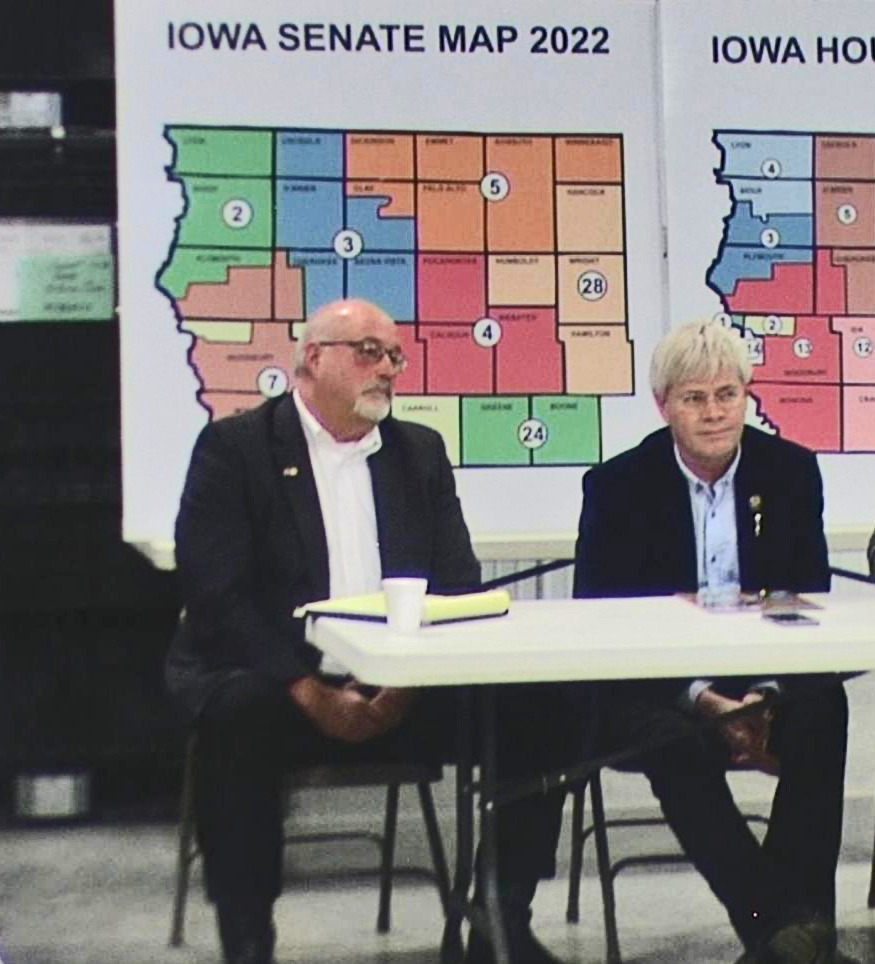
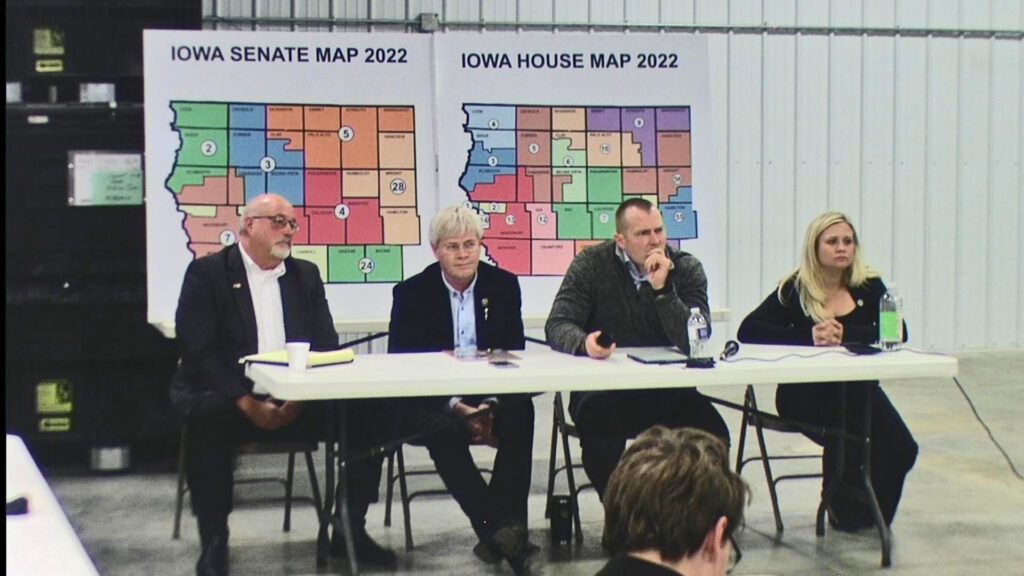
On Thursday December 29 four area elected officials to the State of Iowa made the journey through a brief snowfall. The four attendees were Senator Jeff Taylor, Senator Lynn Evans, House Representative Zach Dieken and House Representative Megan Jones. The event was hosted by Producer’s Coop in Gaza and sponsored by Wednesday Morning Group. A crowd of approximately 50 individuals attended. Denise Steffen moderated the event.
Jeff Taylor provided an overview of the process for an idea to become a bill to become a law. The process is fraught with detours and politics. Even great solutions can get lost.
Each elected official gave their committee assignments. Taylor, representing District 2, will sit on the Vice Chair of Education Committee judiciary, workforce, technology and appropriations committees. As such, he will chair the education sub committee of the appropriations committee where funding for community colleges, universities and public k-12 public education gets determined. District 2 is all of Lyon and Sioux Counties and the north portion of Plymouth County.
Dieken elected to the new District 5 House will serve on the ag, environmental protection and public safety committees. Dieken is new to the state house and will be learning much. His seat represents Osceola, O’Brien counties and eastern Cherokee and western Buena Vista County.
Jones is the District 6 representative (southern Clay and eastern Buena Vista Counties, is serving as Chair of the administrative rules committee which makes sure the bureaucrats make rules that follow the laws already passed. She also serves on judiciary, ways and means and chairs the environmental protection committee and the agriculture committee.
Evans is Senator for District 3. He serves the citizenry of Osceola, O’Brien and Buena Vista Counties as well as the eastern portion of Cherokee County and the south half of Clay County. His committee assignments are education, natural resources, health and human services, judiciary, ethics and education appropriations subcommittee.
Steffen asked broadly how money and political pressure might affect each of their positions. She specifically brought up the Iowa Utilities Board (IUB). She pointed out that the IUB has final discretion about all eminent domain questions. It is a 3-person board appointed by governors. Two sitting board members were appointed by Terry Brandstad. The third was appointed by Kim Reynolds. Before the question of political influence was asked the scene was set like this:
“Mr. Branstad works for Summit Carbon Solutions. Richard Lozier is a current IUB board member appointed by Terry Branstad. Mr. Lozier works for a law firm that represents Dakota Access. Josh Byrnes was appointed to the Iowa Utilities board by Governor Reynolds. His daughter is Governor Reynolds assistant. Influence by Governor Reynolds is evident in this case. That may be concerning because Bruce Rastetter is the CEO of Summit Carbon Solutions. He donated $124,898 to Governor Reynolds since 2015 (from OpenSecrets.org). Jeffrey Boeyink is Summit Pipelines VP of Government and public affairs and was Governor Reynold’s Chief of Staff. Further, Governor Reynolds put these people on her Carbon Sequestration Task Force. Her task force has Geri Huser, IUB Chair, Debbie Durham, Iowa Economic Development Authority Director, Kayla Lyon, Iowa DNR Chair, and Scott Marier, Iowa DOT director. Strategic influence being exercised by Summit Pipeline and Navigator on our elected and appointed officals.”
The question, “Is there anything you can or will attempt to do to protect landowners from eminent domain being exercised by for profit entities with strong political ties and influence?”
Jones started with her position. Her husband farms and rents 4 pieces of property affected by the pipeline. She is not allowed to give input into any legislation that might give her a personal financial gain. She does want to join a future conversation, should one arise about eminent domain.
Dieken does not own farmland. He has had discussions and wonders what it “might look like to make it illegal to just pipe CO2.” He stays consistent that the governmental regulation is affecting so many.
Taylor reminds the crowd that many people are excited about pipeline. He traced the impetus of this back to the “Green New Deal” funding this pipeline. He understands the argument of dollars for ground, keeping ethanol markets open and the high price of corn. He also stated that eminent domain is not appropriate in this case. He referenced both the state and U.S. Constitutions where eminent domain is defined. Very clearly, eminent domain is for public use. He says there is no public use here at all. The pipelines will be built by private companies piping a product that will not be used by the public. It will be used by a private company for private profit. “For that reason I believe it would be unconstitutional for the IUB to grant eminent domain for these projects.” He states that the legislature should step up and remove it from the IUB to make the decision, removing the political pressure from them. A bill did not make out of sub committee, but he feels there is more attention and new legislators paying attention to it. He also feels that if a company is going to ask for eminent domain they should be required to publish all of their investors. His comments drew applause from the crowd.
Evans says the ethanol has been good for crop prices and communities. He did make comments about future concerns for selling ethanol to the federal government or other markets as production is right now. He does, however not feel that eminent domain is appropriate in this instance.
Moving to the next question and staying with the concerns for political/financial influence Steffen said, “We have witnessed Governor Reynolds using money and politics to influence law makers. For example the Governor endorsed two house candidates after the school voucher vote when some Republican congressmen did not support her position on school vouchers and the bill did not pass. One of the two candidates Governor Reynolds endorsed was Zach Dieken. Congressman Elect Dieken, can you assure the taxpayers that political power will not influence your decisions to represent the taxpayers and voters in your district?
Dieken said that he was endorsed on the education thing alone. “I’m brand new to all this. I think it surprised everybody especially me.” He went on to identify several legislative issues that he believes he and the governor disagree. He named the pipeline issue, in his opinion the life issue, restricting her governing powers in an emergency situation. He then thanked his supporters.
Steffen asked the for the position of others on the panel about their positions on school vouchers. Evans, a former educator spoke first. He is not necessarily opposed to the vouchers. He believes it will affect about 2% of the students. As long as we provide the finest education possible for all students he is not opposed to vouchers. He has ideas about how to achieve this and welcomes questions and discussions about the issue.
Taylor supports school choice and has attended to some gatherings of supporters. He noted much of this is for Christian schools. He does not feel that the two education systems should be pitted one against the other, that private education should not be provided from the backs of public education. He spoke highly of public schools and school officials in Iowa and particularly northwest Iowa. As a member of the education appropriations subcommittee he plans to sufficiently fund schools to maintain or improve the education provided, he also want something different. He has supported the governor’s ESA bills in the past and probably will in the future.
Jones feels that it is unfair to pit public against private schools. He needs to make sure that public schools are well funded, especially during a time of inflation and hard to fill open jobs. She does feel that there are times that public finance of certain kinds of private or specialty education might be appropriate.
The Iowa Natural Resources and Outdoor Recreation Trust Fund was addressed. The fund has been unfunded for several years. The fund was established with the intention to increase the sales tax to fund it. A specific division of spending was stated with the question to the elected officials how they will handle the lobbyists for this fund.
Jones says she will listen to her voters back home, not the lobbyists, but does want to be educated on each topic. She wants any tax increase to be budget neutral – if sales tax goes up other taxes go down. Land acquisition and water quality components in the bill cause Jones concern about the bill.
Dieken reiterated that he is new to this and learning a lot. He immediately expressed concern for increasing taxes for something like this. Dieken, although is open about his healthy distrust of government, says he says maybe DNR wants to do or is doing but needs more oversight. He wants to propose legislation to give more oversight to DNR until “we figure out exactly what it is they will be doing with the money.”
Taylor is less concerned with the lobby than the voters overwhelmingly approving the trust fund. He says it remains popular with most Iowans. Taylor expressed his support for how the bill would trigger other cuts that would also help support local funding. He did not give details. Taylor went on to share how he learned of DNR partnerships with private organizations such as Iowa Natural Heritage to bid up certain properties and price them out of reach for local farmers. He does support legislation that requires DNR to take care of the land they have and not get more land. He suggested that a moratorium on the purchase of more land might be something to consider.
Evans agrees the money should be spent on the land they have, improving the land. He talked about the sales tax being a regressive tax, which hits the people with the least the hardest. He is against raising sales tax from this standpoint alone. He also is not in favor of a moratorium on DNR purchasing more land. Some counties may not have enough to provide good public recreation.
Steffen asked a question about the complex question of ownership of precious metals. West Virginia is proposing legislation to not tax precious metals. Most were not versed enough on the issue of precious metals as legal tender and the federal reserve banking system. The base of this question was about the federal government not being able to take gold or silver from private citizens. Dieken spoke about the sovereignty of the state. Jones spoke to finding certainly that the gold or silver is real.
Questions then went to members of the audience.