
Life Given in Service

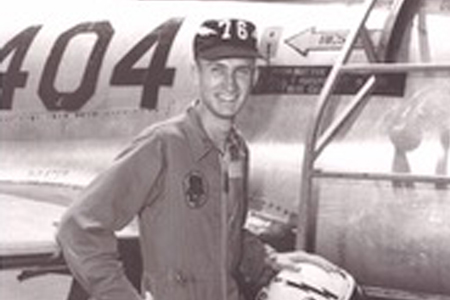
Major James Roger Metcalf, 38, the Primghar Class of 1950 Class President and Valedictorian, gave his life for his country. Metcalf graduated Minnesota University in 1954 and married Donna Roach in Esterville, Iowa on December 27, 1955. They had 3 daughters.
One high school classmate, Charles Bolender describes Roger this way:
“Roger was my very best friend while growing up in Primghar. He had a very bright and inquisitive mind and also a dry sense of humor. We remained close as we went off to college – Roger to the University of Minnesota and me to the University of Iowa (College of Dentistry). It was an honor to serve as best man in Roger and Donna’s wedding in Dec. 1955.
Over the past 50 years Roger has remained in my thoughts. Occasionally something will remind me of him. So his spirit has definitely lived on in my mind and probably in the minds of many others from his past.
Please tell you husband Thanks from Mamie and me for arranging to have Roger’s flag flown over the Pentagon on June 3. I plan to fly our flag at half staff on that day.”
Roger died near Centenera, Spain on June 3, 1971. He was piloting a KC 135 Q model, also known as a flying gas station. The plane was part of 306th Bombardment Wing at McCoy Air Force Basse in Florida. The crew was attached to the 509th Bombardment Wing at Pease Air Force Base. Five crew members were the occupants of the plane. There were no survivors.
Prior to piloting the KC-135 Metcalf served as a commanding officer of a physiological training unit conducting lectures and training in a high altitude chamber (required training of all crews every three years). And he was an instructor pilot.
In recognition of this accident 50 years before, a flag will fly over the Pentagon on June 3, 2021.
Reports of the accident first appeared only 10 years ago. The accident report says, the plane “Crashed following in-flight explosion of the No. 1 main fuel tank. Chafing of boost pump wires in conduits was determined to be as a possible ignition source. The tanker plane was on its way back from a routine refueling mission over the Mediterranean and crashed at the village of Centenera, 35 kilometers northeast of Madrid-Torrejon AFB.”
Crew Chief Bob was there that day. He is identified as Pogo Bob. He described the operations and events of the day:
“I was at Torrejon when we lost that one. Torrejon didn’t have any PCS 135’s at that time, all transients. They had a permanent maintenance organization, but no planes. Ground crews stayed with their own birds, but the flight crews rotated among different aircraft. 039 was a McCoy bird. I was a crew chief at McCoy from 4/70 to 9/73 and the Spanish Tanker Task Force was one of our regular gigs. It was a 30-day TDY (I pulled five of them). We kept two birds over there all the time, rotating one every two weeks.
I was in the middle of my month (I think I had 036 that trip) and 039 was supposed to rotate home the next day. 039 was actually standing spare that day. My bird was one of the two primaries and the other primary, a Blytheville bird, aborted for a blown water line. 039 immediately cranked up and nearly ran over my buddy Horne trying to get out of the chocks (Horne had to use the rear chock to knock the front one loose after they rolled up on it) Then he was barely able to get clear after disconnecting the headset. I remember he wanted to “have a chat” with that AC. He never got the chance. After the mission, we’re in the line truck waiting to recover the birds… Mine landed first, 039 was 10 minutes behind and 042 (039’s replacement) was inbound from McCoy 10 minutes behind 039. Well, Mine landed and 20 minutes later, 042 landed. 039 had blown out of the sky several miles out. The Pease flight crew plus an IP were all killed. When they brought it into the base, the biggest piece I saw was a section of the vertical stab. The last we heard was that it was initiated by an electrical short in the vicinity of #1 main tank (either the boost pumps or possibly the strobe light wiring – Q’s had strobes). Via the fuel vent system, the explosion took the whole left wing pretty much instantaneously. As you can imagine, the yaw from that pretty much disintegrated the bird and scattered it over hell’s half acre. Sad day.”
Sue Chandler, eldest daughter of Metcalf, found the post by Pogo Bob. On the day of the disaster she was 13. Her two sisters were 10 and 6 at the time. As any loving child would, she was full of questions. She asked the knowledgeable stranger about the mission, time of crash, weather. She was curious about what the flight crew might have been doing. She asked about the meaning of the lingo Pogo used in his posting. Mrs. Chandler even described how “for years my mother attempted to find out what happened and never could until the link to the accident appeared last fall. (February 14. 2011) She explained how they had been told that they were doing touch and go’s and the plane was hit by lightning from a severe thunderstorm and exploded.
They shared an emotional and comforting conversation via phonecon. Here, Pogo Bob posted, “All of our fliers put their lives on the line for us daily. In this case, it occurs to me the unfortunate crew were unwitting heroes, as the bird’s next scheduled flight was to rotate home the next day, likely with 50+ passengers aboard. There is no reason to think the aircraft would not have met the same fate.
We can be grateful for their sacrifice.”
Rich Dugas on January 9, 2017 posted to Sue, …”I was a comm./nav troop tasked with taking the TOs (technical orders) to crash site.” He described the of the crash site which was near a village and no houses were hit and it is believed that there were no civilian casualties as a result of this crash adding, “by the grace of God.” There is debate if the crew was able to place the location of the crash, but a Colonel at the scene and KC pilot is quoted as saying he thought the crew has some control. Mr. Dugas was tasked with collecting personal belongings of the crew. He said, “In my eight years this was absolutely the toughest thing I had to do. It has been over 40 years and every time I see a picture of a KC I think of this and wonder how the families are now. Pray for them often.”
Major Roger Metcalf is buried in Pleasant Hill Cemetery in Primghar with the Metcalf family.
A flag will fly over the Pentagon on June 3, 2021 in recognition of the fatal plane crash 50 years prior. Arrangements are underway for the flag to be sent to Primghar where it will be displayed permanently.