
Second CO2 Pipeline Developer Holds Public Meeting
By Mari Radtke
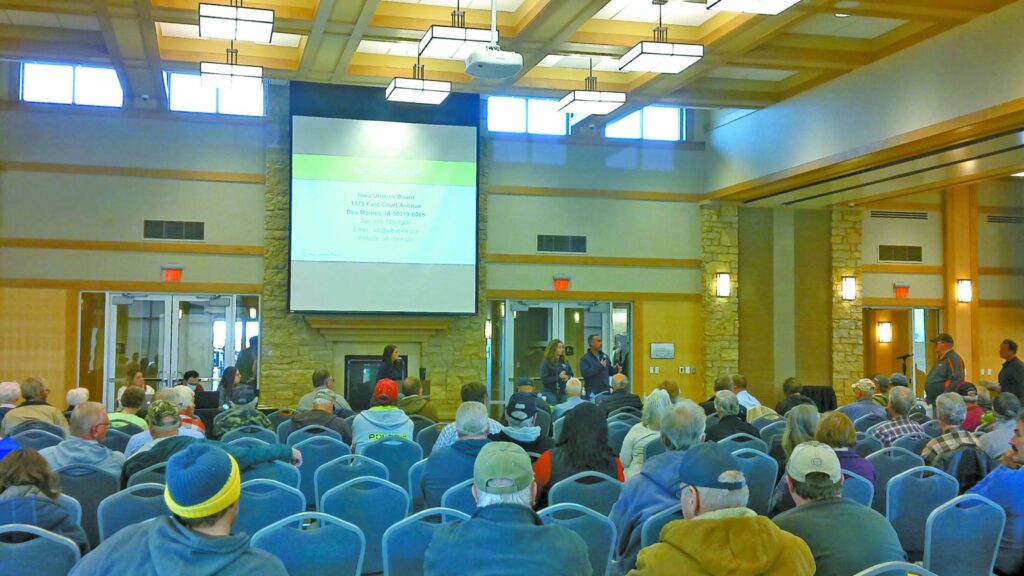
Navigator Heartland Greenway LLC (Navigator CO2 Ventures) held its required public meeting for O’Brien County on Wednesday December 1 in Sheldon. Attendees at the Pavilion event numbered around 200 with approximately 20 people asking questions or leaving verbal comments. The required informational meeting is a requirement of Iowa Utilities Board (IUB) before a proposed utility project can apply for a permit, enter into negotiation with landowners or be eligible for imminent domain use.
Representatives of IUB and Navigator CO2 Ventures were in attendance at the meeting. IUB representatives were there to verify that Navigator CO2 Ventures properly conducted the public meetings and addressed, clearly, all of the requirements of the developer. Following the company’s opening statements, IUB asked for a few clarifications and considered the information provided to the public complete. A comment and question period for both IUB and Navigator CO2 Ventures followed. Attendees lined up to ask questions of both entities and give information about the facts of burying a pipeline in the proposed route.
Navigator CO2 Ventures proposed to conduct land easement negotiations and permitting through 2023. They hope to begin the construction project in 2024.
Construction details were shared. This CO2 pipeline is 1300 miles with 900 of those miles in Iowa. Feeder pipelines from Nebraska, South Dakota and Minnesota are part of the project with the destination of the pipeline being central Illinois. The pipeline is designed to be capable of carrying 15 million metric tons of CO2 (described as the equivalent of 3.2 million passenger vehicles) from 20 receipts points to deep burial in Illinois. This CO2 is to come from ethanol and fertilizer plants in the 5 states.
Supervisor Dan Friedrichsen asked about any possible regulatory role the governing body may have on the construction of the pipeline. Friedrichsen’s question left it clear that the terms negotiated for each parcel is the responsibility of the landowner. Supervisor Dennis Vanden Hul explained the Summit Pipeline presented in October was nicely plotted on the half miles and wondered why this pipeline needed to build diagonally across tiled fields. No clear answer came.
Landowners present took turns asking questions and leaving comments – which are not part of the permanent record used by IUB to reach any permitting decisions. One landowner in the northeast corner near Hartley explained that he has 5 utility easements on some of his fields. He wanted to know which easement took priority. No answer. He also explained that the 3 years Navigator CO2 Ventures proposed to reimburse for lost productivity is insufficient making several statements. One was that the soil separation is poor. The digging interferes with soil fertility and that in his experience it took at least 8 years for productivity to returning, if at all.
Pipeline depth was a recurring concern. Representatives of Navigator CO2 Ventures say they are looking at a 60-inch depth to the top of the pipe. That depth could get below much of the existing underground infrastructure in the area. They also emphasized their need and desire to discuss the uniqueness of each parcel they plan to build on including infrastructure, sensitive features like historical value and future plans such as building or tile improvement to include future (above-ground) development.
Ownership of Navigator CO2 Ventures and pipeline financing was brought up. Ownership of the parent company, Navigator, was also brought up. Public documents indicate that finances for the project include funds from an investment fund and from sovereign countries. Representatives denied any knowledge of the financial sources of the parent company or the specifics of this project.
Safety is a major concern about a pipeline under a minimum of 1300 psi. Transporting CO2 via pipeline is a fairly new technology. CO2 under this kind of pressure is explosive. CO2 is an asphyxiate in some of its forms. How it will react in the air after an explosion or in the ground or air during or after a leak is not fully known. Questions about human and livestock safety were asked, but not clearly answered. Pipeline representatives acknowledged they do provide training to local emergency response organizations. In Iowa, a pipeline operator is required to provide safety training. Representatives also indicated they would provide departments with what is needed to respond to a CO2 pipeline emergency. They did not indicate any specifics about money or equipment.
Any person can have a question or comment about this pipeline entered into the permanent record and included in the final decision by submitting an online question or comment to iub.iowa.gov. and clicking on the electronic filing system link on the right of the home page. This pipeline reference number is HLP-2021-0003.
The entire meeting can be viewed on our YouTube Channel. Search for belltimescourier to find the video of the full meeting.